.jpg)
FSTE Companies Trends: What the Latest Reports Say About UK Boardroom Diversity Trends

When you look at top UK businesses today, corporate boards look very different than they did five years ago. Reports like the Parker Review, the FTSE Women Leaders Review, and the Spencer Stuart UK Board Index track these changes every year. While top 100 companies hit diversity goals faster, medium sized FTSE 250 firms move slower, and clear gaps remain for specific groups.
Ethnic Diversity: FTSE 100 Leads While FTSE 250 Lags.
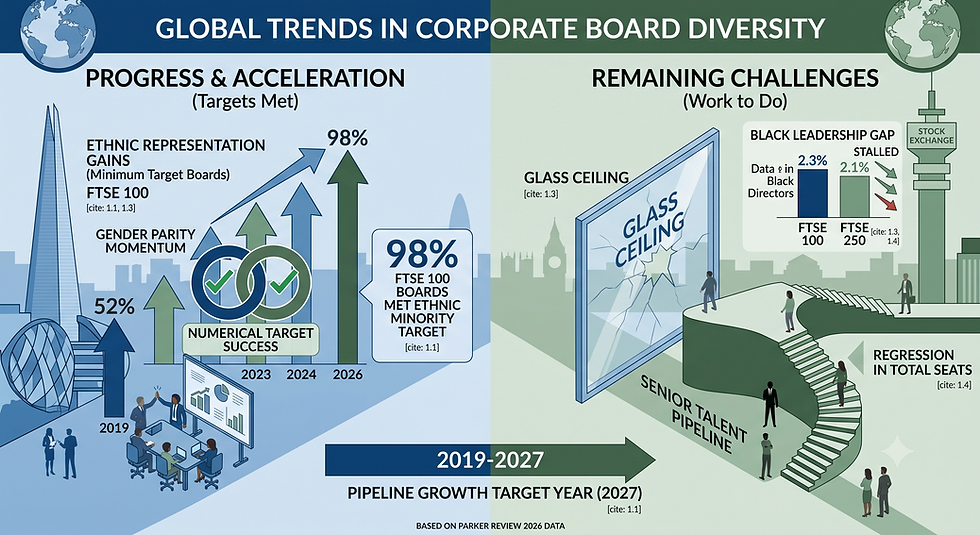
Data from the Parker Review shows that Britain's largest listed corporations have met basic board targets. In the FTSE 100, 98 percent of company boards now have at least one director from an ethnic minority background. That is up from 52 percent in 2019. Across all board seats in the FTSE 100, ethnic minority directors hold 20 percent of total positions.
Mid cap companies in the FTSE 250 show steady movement but fall behind. Right now, 82 percent of FTSE 250 boards have reached the target of one minority director. Ethnic minority directors fill 16 percent of board seats across the FTSE 250. Spencer Stuart research notes that smaller board sizes and lower seat turnover in mid-sized companies make adding new leaders more difficult over time.
Gender Representation Shows Strong Overall Numbers.
The FTSE Women Leaders Review shows strong overall gains for female directors. Women now occupy 42.6 percent of board seats in the FTSE 100 and 41.8 percent in the FTSE 250.
However, women rarely fill the top executive jobs. Data from Spencer Stuart and Deloitte shows women hold 47 percent of Senior Independent Director roles but occupy only 15 percent of executive director seats and just 10 percent of Chief Executive Officer roles. Boards have added female non-executive directors, yet top day to day operational roles remain mostly male.
The Senior Management Pipeline Problem
Getting a non-executive board seat is one thing, but getting promoted into senior executive teams is another story. In the FTSE 100, ethnic minority managers fill only 11 percent of UK senior management roles. In the FTSE 250, that number drops to 10 percent.
The FTSE Women Leaders report points out a similar pattern for gender. Women hold 35.2 percent of leadership roles below the board in the FTSE 100 and 33.9 percent in the FTSE 250. Progression slows down in the middle management layers across both indexes.
The Stalled Progress for Black Leaders:
Broad ethnic statistics often hide what is happening to specific racial groups. When you look strictly at Black talent, progress has slowed down or lost ground.
In the FTSE 100 UK, Black directors fill only 2.3 percent of board seats. Over the past year, the total count of Black directors in the FTSE 100 dropped from 25 to 24 seats. In the FTSE 250, Black board seats fell from 42 to 37, dropping representation to 2.1 percent.
In FTSE 100 senior management teams, Black managers hold just 1.3 percent of roles, even though Black workers make up 3.9 percent of the UK working age population.
What Companies Need to Do Next
Hitting board count targets is a basic step, but it does not automatically fix workplace fairness. To make lasting change, companies across the FTSE 100 and FTSE 250 must publish specific numbers for Black professionals instead of grouping all minorities together. Businesses need active career sponsorship, fair promotion practices, and real accountability from senior managers to build strong talent pools for the long term.


Comments